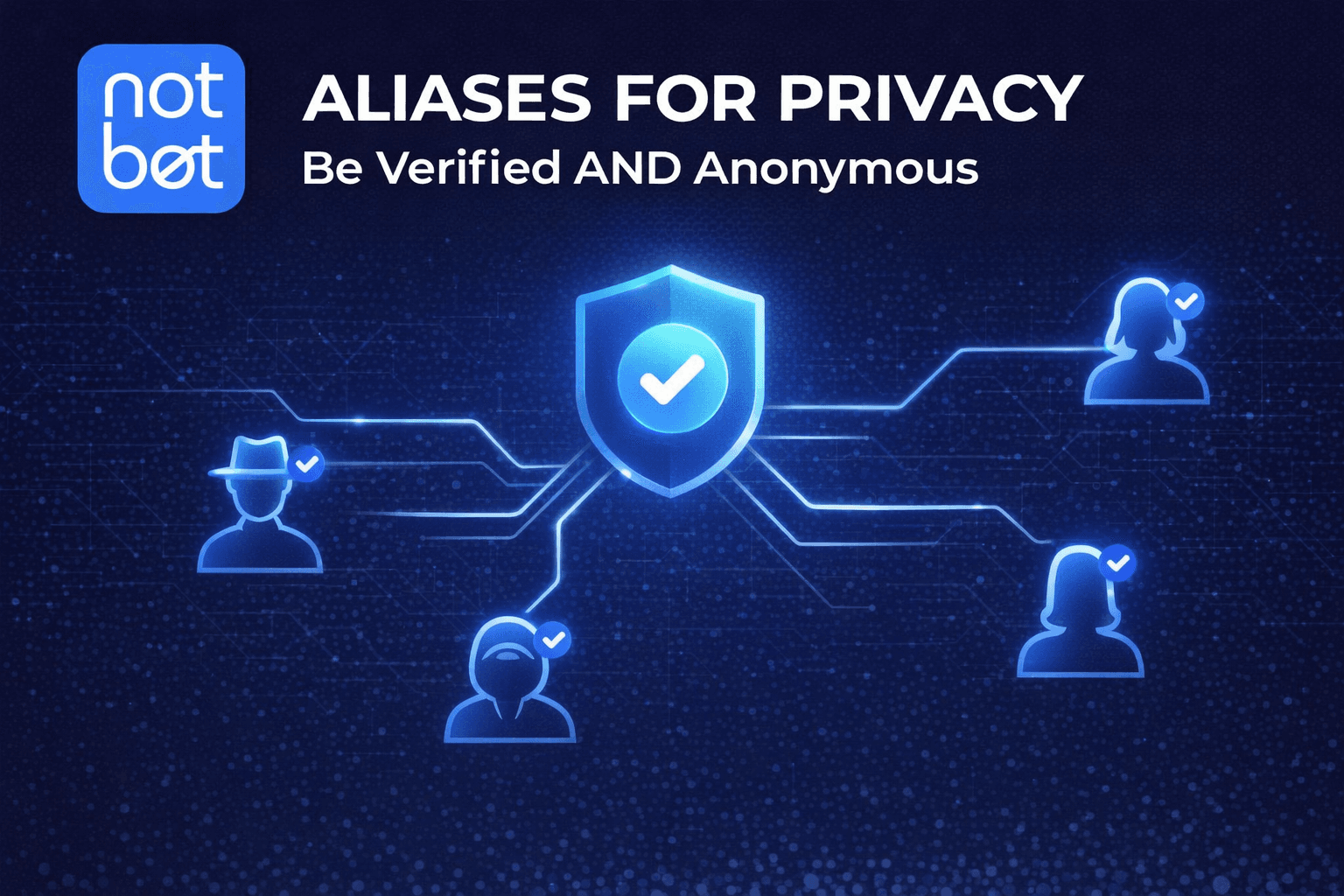
Aliases for Privacy
Here's a question that comes up constantly: "If I verify my identity, doesn't that mean I lose my privacy?" The assumption behind this question is that identity and privacy are opposites. That you must choose one or the other. We built not.bot to prove that assumption wrong. The False Choice For decades, the internet has forced users into a binary decision: Option A: Full Identity Use your real name, verify your government ID, link your accounts. Platforms know exactly who you are. You get access to features that require trust. But you have zero privacy. Option B: Full Anonymity Use a pseudonym, reveal nothing. You get privacy. But you also get treated as suspicious. No verification badge. Limited features. And you're swimming in a sea of bots using the same anonymity to wreak havoc. This binary choice has defined online identity for 30 years. And it's a false choice. Why Privacy and Verification Aren't Opposites The key insight of personhood credentials is that you can prove facts without revealing details. "I am a real, unique human" is a fact. "My name is John Smith, I live at 123 Main Street" is a detail. Cryptographic verification can prove the first without ever revealing the second. You don't need to know who I am to know that I'm a real person and not the 500th bot account created this hour. This is the foundation of not.bot's alias system. How Aliases Work not.bot allows you to create and manage multiple aliases—all backed by a single verified human identity. Your verified identity: Confirms you're a real, unique human Established once during initial verification Never shared with platforms or other users Cannot be duplicated (one person, one verification) Your aliases: Pseudonymous identities you create Can be used on different platforms Unlinkable to each other (unless you choose to link them) Each proves "verified human" without proving "which human" Think of it like having multiple email addresses. Your personal email, your work email, your throwaway email for signups. They're all you—but compartmentalized based on context. not.bot aliases work the same way, except each one also proves you're a verified human. Use Cases for Aliases The Creator You have a professional persona and a personal one. You don't want your gaming reviews linked to your LinkedIn presence. With not.bot: Different aliases for different contexts. Both verified as human. Neither linked to each other unless you choose to link them. The Whistleblower You want to expose wrongdoing at your company. You need credibility—random anonymous tips get ignored. But you can't reveal your identity without risking retaliation. With not.bot: Create an alias. Your posts are verified as coming from a real human (credibility). But your identity remains protected (safety). The Job Seeker You want to participate in industry discussions and build credibility. But you don't want your current employer to know you're job hunting. With not.bot: Use an alias in relevant communities. You're clearly a real professional (verified human), but your current employment status stays private. The Domestic Violence Survivor You need to engage online—for community, for work, for basic services. But you can't risk your abuser finding you. With not.bot: Verified presence without location or identity exposure. You exist online safely. The Dating App User You want matches to know you're real (not a catfish, not a bot). But you don't want to share your full name until you're comfortable. With not.bot: Verified as human on your profile. Real name shared only when you're ready. The Technical Foundation Aliases work because of how cryptographic verification operates. When you verify with not.bot, we confirm you're a unique human. This creates a cryptographic root identity—a mathematical proof of your personhood. Aliases are derived from this root identity in a way that: Proves connection to a verified human (without revealing which one) Prevents linkage between aliases (unless you explicitly link them) Allows selective disclosure (reveal more if you choose, but never forced) This is multiparty computation in action. Proving facts without revealing data. Privacy When You Want It, Publicity When You Don't The real power of aliases isn't just privacy. It's control. Sometimes, like with social media, you want to be anonymous. A verified alias handles that. Sometimes, like for work, you want to be public. Connect your alias to your real name and build reputation. Sometimes you want selective disclosure. Reveal your profession but not your employer. Reveal your city but not your address. Reveal your age range but not your birthday. not.bot doesn't force a single mode. It gives you the tools to navigate digital identity on your terms. What This Means for the Future As governments worldwide push for online identity verification, the question of privacy becomes urgent. The heavy-handed approach: "Scan your ID to post online. No privacy. Full surveillance." The not.bot approach: "Prove you're human. Keep your privacy. Engage on your terms." Both verify. But only one respects autonomy. Aliases aren't a workaround or a loophole. They're a fundamental feature of privacy-preserving verification. They're how we prove the "identity vs privacy" choice was always false. You shouldn't have to choose between being verified and being private. With not.bot aliases, you don't have to. Privacy by default. Share only when necessary. Control always.