Why Detection Always Fails: The Mathematical Asymmetry You Can't Beat
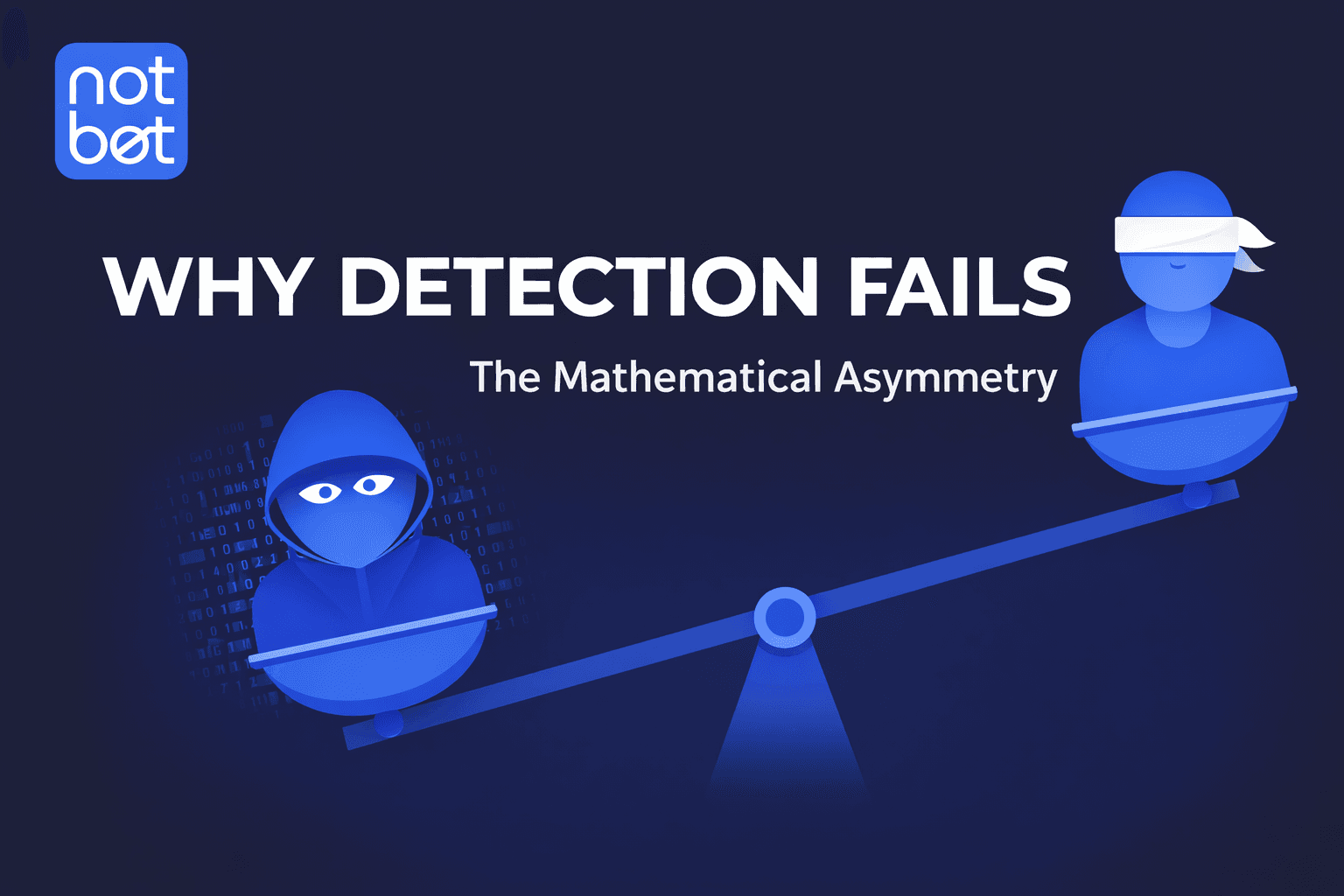
Here's a truth that most security vendors won't tell you: detection-based security is mathematically doomed.
Not eventually doomed. Not doomed if AI gets smarter. Structurally doomed from day one.
There's a fundamental asymmetry built into every detection system that guarantees generators will win over time. Understanding this asymmetry is the key to understanding why verification is the only path forward.
The Numbers Right Now
Let's start with where we are today. According to fraud researcher David Birch:
- 73% of web and app traffic is now malicious bots or fraud farms
- 80% of US identity fraud is synthetic identity fraud (AI-generated)
- $5 billion lost annually to synthetic identity fraud alone
- 40% of reported crime in the UK is fraud-related
- Only 1 in 6 fraud incidents are ever reported
These numbers are staggering. And they're getting worse every year.
Why? Because detection can't keep up with generation.
The Asymmetry Problem
Here's the mathematical truth at the heart of every detection system:
Generators get feedback. Detectors don't.
When a generator (a bot, a deepfake creator, an AI agent) tries to pass detection and fails, it learns exactly why. The rejection message, the error code, the behavior that triggered detection—all of this becomes training data for the next attempt.
When a generator tries to pass detection and succeeds, the detector has no idea it failed. It can't learn from mistakes it doesn't know it made.
Think about what this means:
- The attacker sees every game played—wins and losses
- The defender only sees their wins
Over time, attackers learn from every failure while defenders are blind to their failures. The system improves on one side only.
This isn't a fixable bug. It's a structural feature of how detection works.
Why Deepfake Detection Plateaus
This explains a pattern that frustrates security researchers: why deepfake detection tools plateau at 70-80% accuracy while generation quality keeps improving.
Detection tools are trained on known deepfakes. They get good at catching those deepfakes. Then generators learn what detection looks for and avoid it. New deepfakes pass detection. But researchers don't know which ones passed—so they can't train on them.
The generator-detector arms race is inherently asymmetric. Generators iterate on failures. Detectors can only iterate on known successes.
Why Spam Filters Never Win
The same asymmetry explains the endless spam filter arms race.
Spam filters catch known spam patterns. Spammers learn which messages get through. They generate more messages like the successful ones. But the filter doesn't know which spam got through—only which it caught.
After decades, spam remains a massive problem. Not because filter developers are incompetent, but because the asymmetry can't be engineered away.
Why CAPTCHAs Died
CAPTCHAs are the purest example of detection failure.
CAPTCHAs got harder. Users got frustrated. Bots got smarter. Eventually AI could pass CAPTCHAs more reliably than tired humans.
The arms race was unwinnable because:
- Every CAPTCHA failure taught AI what to improve
- Every CAPTCHA pass taught humans nothing about bot success
In July 2025, OpenAI's ChatGPT agent casually clicked through "I am not a robot" verification. The detection era is officially over.
The False Positive Problem
Asymmetry creates another problem: false positives punish real people.
To catch more bad actors, you make detection stricter. Stricter detection means more false positives—real humans flagged as bots, legitimate transactions blocked as fraud.
These false positives have real costs:
- Customer friction and abandonment
- Support ticket overload
- Reputation damage
- Lost revenue
So you loosen detection. Now more bad actors get through.
You're trapped between false positives (hurting real users) and false negatives (missing bad actors). There's no detection threshold that solves this—because the fundamental asymmetry remains.
Why "Better AI Detection" Isn't the Answer
When people see AI-generated fakes, they often ask: "Can't we just use AI to detect AI?"
No. Here's why:
- Same asymmetry applies — AI detectors face the same feedback problem as any detector
- Training data poisoning — Generators can be trained specifically to fool detectors
- Convergent quality — As AI generation improves, generated content becomes statistically indistinguishable from real content
- Cat and mouse acceleration — AI makes both sides faster, but the asymmetry advantage still favors generation
"Better detection" is still detection. The asymmetry doesn't care how sophisticated your detector is.
The Alternative: Verification
If detection is structurally doomed, what's the alternative?
Verification.
Instead of asking "does this look real?" we ask "can you prove it's real?"
Verification doesn't face the asymmetry problem because:
- Cryptographic proofs don't degrade — A valid signature is valid forever; there's no "fooling" math
- No false positive problem — You either have valid proof or you don't
- No feedback loop — Attackers can't learn to generate valid proofs without the actual credentials
A deepfake video can look perfectly real. But the person depicted can't cryptographically prove they recorded it.
An AI agent can pass a CAPTCHA. But it can't cryptographically prove it's tied to a verified human identity.
A synthetic identity can look authentic. But it can't cryptographically prove it was created by a real person.
From Probabilistic to Certain
The shift from detection to verification is a shift from probabilistic guessing to mathematical certainty.
Detection says: "This is probably real (73% confidence)." Verification says: "This is cryptographically proven real."
In a world where AI can generate anything convincingly, probability isn't enough. Only mathematical proof provides reliable ground truth.
The arms race between generation and detection is over. Generation won—not because generators got smarter, but because the asymmetry was always in their favor.
The future belongs to verification. To cryptographic proof. To systems that don't guess whether something is real, but know.
That's what we're building.