The Brand Impersonation Crisis: They're Not Just Stealing Your Identity—They're Stealing Your Customers
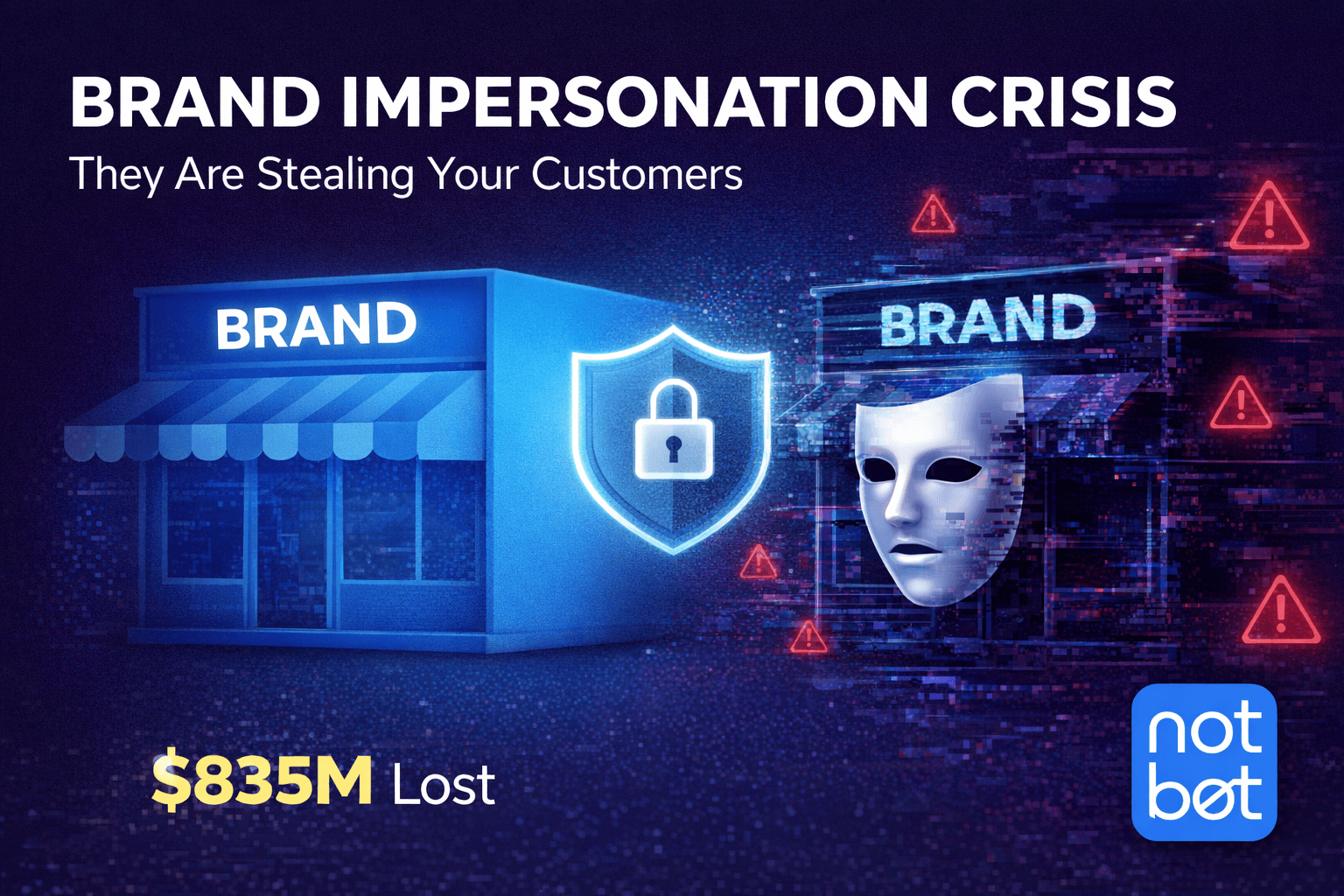
$835 million.
That's how much scammers stole from 396,000 Americans in just nine months of 2025—using fake customer service numbers impersonating major companies.
That's an 18% increase from 2024. And it's accelerating.
Welcome to the brand impersonation crisis.
It's Not Just Big Tech Anymore
The playbook used to be simple: create a fake login page, harvest credentials. That was phishing 1.0.
Now it's evolved into something far more sophisticated. Criminals are creating entire fake customer service operations, complete with:
- AI-generated phone agents that sound indistinguishable from real support staff
- Deepfake video representatives for "premium" support escalations
- Fake branded websites with AI-generated product photos that look legitimate
- Counterfeit social media accounts responding to customer complaints
Large retail chains now report receiving more than 1,000 AI bot calls per day from fake customer service operations impersonating their brand.
The Anatomy of a Brand Hijack
Here's how a typical brand impersonation attack works in 2026:
Step 1: The Hook Scammers purchase Google ads for "[Your Brand] customer service" or "[Your Brand] support number." When frustrated customers search for help, they find the fake number first.
Step 2: The Deepfake When customers call, they're greeted by an AI voice clone that sounds exactly like your brand's customer service style. Some operations even use real-time deepfake video for "video support calls."
Step 3: The Extraction The fake agent "verifies" the customer's identity by asking for account numbers, Social Security digits, or payment information. By the time customers realize something's wrong, the damage is done.
Step 4: The Ripple Effect Angry customers blame your brand. They post negative reviews. They dispute charges. They tell their friends. Your reputation takes the hit for fraud you didn't commit.
Why This Is an Existential Threat
Pindrop's research found that 3 in 10 retail fraud attempts are now AI-generated. This isn't a fringe problem—it's the new normal.
The business impact goes beyond direct fraud losses:
- Customer trust collapse: Once burned by a fake support call, customers question every interaction with your brand
- Reputation damage: Review sites fill with complaints about "your" terrible service
- Support costs explode: Real support teams spend hours explaining to customers they were scammed
- Legal exposure: Depending on jurisdiction, brands may face liability questions for inadequate consumer protection
And here's the terrifying part: the tools to do this are now available as a service.
Deepfake-as-a-Service Changes Everything
According to Cyble's research, AI-powered deepfakes were involved in over 30% of high-impact corporate impersonation attacks in 2025. This isn't nation-state attackers—it's organized crime using subscription services.
For as little as a few hundred dollars, criminals can now:
- Clone any voice from public audio samples
- Generate real-time deepfake video calls
- Create convincing branded content at scale
- Automate entire fraud operations
The barrier to entry has collapsed. Anyone with a credit card can impersonate your brand.
Real-Time Deepfakes: The New Frontier
The most alarming development? Real-time deepfakes during live interactions.
Unlike pre-rendered fake videos, real-time deepfakes allow fraudsters to improvise, adapt, and respond naturally during conversations. They're not reading scripts—they're conducting actual conversations while wearing a synthetic face.
Veriff's 2025 Identity Fraud Report found that deepfake attacks now drive 1 in every 20 identity verification failures. The technology is good enough to fool both humans and many automated systems.
What Can Brands Do?
Traditional security approaches—website monitoring, trademark enforcement, customer education—are necessary but insufficient. Here's what actually works:
1. Verifiable Brand Communications Every official communication from your brand should carry cryptographic proof of authenticity. When customers receive a message, they should be able to verify it came from you—not just assume it did.
2. Kill the Phone Number Game Stop relying on phone numbers as your primary support channel. Numbers can be spoofed, cloned, and impersonated. Move to authenticated digital channels where identity can be verified.
3. Educate Proactively Don't wait for customers to get scammed. Tell them explicitly: "We will never ask for your password. We will never call from this number. Here's how to verify you're talking to us."
4. Monitor Your Brand Continuously Use services that scan for fake support pages, fraudulent ads, and impersonation accounts. The faster you find them, the faster you can get them taken down.
5. Embrace Cryptographic Identity The long-term solution is building verification into the foundation of brand-customer interactions. When customers can mathematically verify, through a not.bot signature, that they're talking to the real you, impersonation becomes impossible.
The Future of Brand Trust
FTC data shows Americans lost nearly $3 billion to impersonation scams in 2024, with these scams among the top fraud categories. And 2026 projections suggest hybrid scams combining impersonation with ransomware.
The brand impersonation crisis isn't slowing down. It's evolving faster than most companies can respond.
But there's a path forward. When every legitimate brand communication carries cryptographic proof of authenticity, the impersonators have nowhere to hide.
Because in a world where anyone can fake being you, the only defense is proof that can't be faked.