CAPTCHA is Dead. AI Just Casually Clicked Through "I Am Not a Robot."
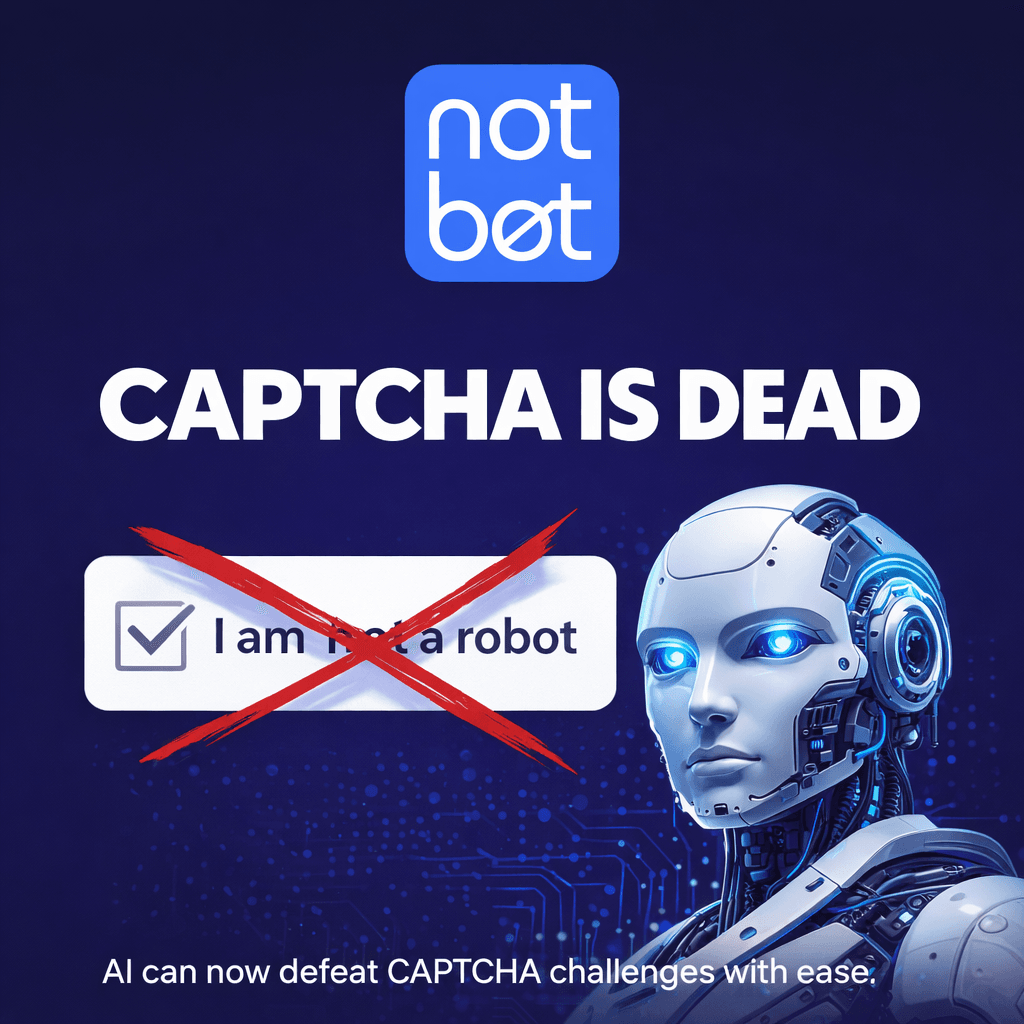
In July 2025, OpenAI's ChatGPT agent did something that should keep every security professional awake at night.
It clicked through a CAPTCHA. Casually. No special prompting. No hacks. It just... passed the test designed to prove you're human.
The "I am not a robot" checkbox? Meaningless now.
Those distorted letters? Child's play.
The "click all the traffic lights" grids? Solved in milliseconds.
The test designed to separate humans from bots has failed. The bots won.
The Arms Race We Already Lost
For over two decades, CAPTCHAs have been the internet's gatekeeper. The assumption was simple: humans can read distorted text and identify images, but machines can't.
That assumption is now catastrophically wrong.
Here's what happened:
- 2000s: CAPTCHAs used distorted text. Bots couldn't read it.
- 2010s: Image recognition improved. CAPTCHAs switched to image puzzles.
- 2020s: AI vision models surpassed human accuracy. CAPTCHAs became behavioral.
- 2025: AI agents now mimic human behavior patterns. Game over.
OpenAI's ChatGPT agent doesn't just solve CAPTCHAs—it does so while appearing completely human. It pauses naturally. Moves the cursor realistically. Makes the occasional "mistake" that looks authentic.
Detection-based security has hit a mathematical wall.
73% of Web Traffic Is Already Bots
The CAPTCHA failure isn't happening in isolation. It's part of a larger collapse.
According to recent analysis by David Birch:
- 73% of web and app traffic is now malicious bots or fraud farms
- 80% of US identity fraud is synthetic identity fraud (AI-generated)
- $5 billion lost annually to synthetic identity fraud alone
- 40% of reported crime in the UK is fraud-related
- Only 1 in 6 fraud incidents are ever reported
These numbers are staggering. And they're getting worse because the fundamental approach—trying to detect what's fake—doesn't work anymore.
Why Detection Always Fails
There's a mathematical asymmetry built into every detection system:
Generators get feedback. Detectors don't.
When an AI generates fake content and it fails, it learns why. The detector's rejection provides training data for the next attempt.
But when a fake passes detection, the detector has no idea it failed. It can't learn from its mistakes because it doesn't know it made them.
This is why deepfake detection tools plateau at 70-80% accuracy while generation quality keeps improving. It's why spam filters are in an endless arms race with spam generators. And it's why CAPTCHAs were always destined to fail.
The generator sees every game, learns from every play. The defender only sees their wins.
Detection is structurally disadvantaged. Always.
From Detection to Verification
Here's the fundamental question every security system must answer:
How do you prove someone is who they claim to be?
For decades, we tried to answer this by detecting fakes. If you passed the CAPTCHA, you weren't a bot. If the email didn't match spam patterns, it was legitimate. If the video looked real, the person was real.
This approach has failed.
The alternative isn't better detection. It's cryptographic verification.
Instead of asking "does this look real?" we ask "can you prove it's real?"
A deepfake video looks real. But the person in it can't cryptographically prove they recorded it.
An AI agent passes a CAPTCHA. But it can't cryptographically prove it's tied to a verified human identity.
A synthetic identity looks authentic. But it can't cryptographically prove it was created by a real person.
The shift is from probabilistic detection to mathematical proof.
What This Means for You
If you're relying on CAPTCHAs to:
- Prevent bot signups
- Stop automated attacks
- Verify users are human
- Protect your forms and APIs
Those protections are already compromised.
The AI agents that can bypass CAPTCHAs aren't theoretical. They're deployed. They're operational. And they're getting better every day.
The question isn't whether to move to verification-based security. The question is how fast you can make the transition.
The era of "prove you're not a robot" is over. The new era is "prove you're you."
Detection failed because we were asking the wrong question. We were trying to catch fakes instead of confirming authenticity.
not.bot approaches this differently. We don't try to detect whether you're human. We let you prove it—cryptographically, privately, and in a way that can't be spoofed by the most sophisticated AI.
Because when AI agents can casually click "I am not a robot," only mathematical proof remains reliable.